Tuesday, May 5, 2015

Albarracin

Albarracin, Spain

Took a bit of time, but I'm finally getting around to summing up my recent trip to Albarracin, Spain. I spent two and a half weeks in this sandstone bouldering paradise with my family and good friends Noah and Siemay and their son Zun. The trip started off slow with 5 straight days of rain and a medley of sicknesses passing through our group. Slowly we started to recover, though, and the clouds cleared into perfect glorious sunny days. What followed was an amazing collection of days climbing till we couldn't physically get up another problem.

Beautiful streets of Albarracin

Albarracin is an ancient fortified city in the mountains half way between Madrid and Valencia. The old stone walls, narrow streets, and complete disrespect for any Euclidean order in the layout of the buildings results in a unique, beautiful base camp for a bouldering trip. We were able to find a great apartment just outside of the city and only a 10 minute ride to the boulders.

Classic Spanish paella

The climbing in Albarracin is characterized by steep pocketed roofs that quickly round out to challenging mantels with sparse slopey holds and few feet. However, there are many great problems that break this mold. The bouldering zones are tightly packed with problems of all difficulties. It really is a treat to spend time in an area where you see classic problems every where you look and never run out of fun, brand new problems to try.

Sandy working a 7a with mean mantel

There were definitely some highlights from the trip: Orion, Zatoichi, Brainstorm, ... to name a few, but really it was the volume that made it so much fun. We beat ourselves down every climbing day trying to do as many problems as possible. Taking this approach, we had to leave behind a few lines that were a bit too hard, but ended up climbing many more classics than we would have if we hunkered down and projected just a few. It was totally worth it!

Me flashing Brainstorm 7b+

The other amazing aspect of the Albarracin forest is that it's an endless bouldering paradise for kids. My son Bayes and Noah and Siemay's son Zun (both 3 years old) had a blast climbing miniature 4 star lines. The problems where Mandalas and Midnight Lightnings scaled down to 1/3 size. It was awesome to see the kids develop during the trip climbing. By the end, they were climbing legitimate problems that were actually listed in the guidebook.

Bayes trying hard on an undone kids problem

The trip was a great success and a fun new experience in a new location. Definitely a great place to visit for many reasons. Hope you enjoy a few photos from the trip and a short video I put together.


Tuesday, February 10, 2015

New Scoring System for ABS Nationals

With all the talk going on about the new scoring system at this year's ABS bouldering nationals, I thought I should chime in on the discussion with my two cents. 

First off, I think bouldering is too nuanced to ever be perfectly scored. The new system obviously has its criticisms, but most other methods fall down in certain cases too.* All in all, I think the new system has some real merits. Here's my stab at giving a better explanation of and a rationale for this new method of scoring. 

Imagine a competition series with 4 different events spread out over time. After each event you can rank the athletes by their performance (assuming some scoring system for the event). If you want to crown a winner for the whole series, you need a way to combine the per-event rankings. A simple way to do this is to combine the ranking each person got in the event (i.e., 1st, 2nd). If there's a tie, find some way to assign points (e.g., average the places where the tie occurred -- this is the scheme ABS used). Now the simplest way to do this combination is to average the rankings from each event to get an overall ranking. The person with the lowest average ranking wins.

Now imagine that each event had only one boulder problem in it. Guess what, you now have the scoring system used in this year's ABS nationals with 2 caveats.

1) The total number of tops trumps your ranking (i.e., average ranking is used just to break ties in the total tops score).

2) Instead of taking the arithmetic mean (average) of the rankings, the geometric mean is used. That's all there is to the nth root of the product of rankings. It's just a different way to compute an average. The geometric mean has the advantage that is suppresses outliers (i.e., doing poorly on one problem has less effect on your overall ranking than with the arithmetic mean). See figure and description below.

The individual boulder problem rankings were determined using a system that we're all pretty familiar with. Namely, highest hold achieved is most important and ties are broken by number of attempts to get that high point. If two people are still tied, then they just split the ranking points. See the full description of the scoring method here.

In my opinion, this new scoring system is completely reasonable and may prove to produce more consistent results than previous methods. It just didn't fare too well in its first showing. I agree that it's a bit complex for the viewer to follow, but none of the other methods are that easy to follow either unless you've been watching comps for years. If the scores are constantly displayed for the viewers, this is less of a problem. I do concede that it's a bit strange that with this new method, the relative ranking of two individuals who have finished climbing can be changed by some climber later in the round. For me, that's not really a big deal though... you just have to wait till the end of the round to know the results. There's a lot more to go into here, but one thing I like about this new method is that it strives to assess the difficulty of each problem in a way that is relative to all the climbers.

As a side note, here's a quick analysis that compares the arithmetic and geometric means for a set of 4 rankings. All 4 rankings have the same arithmetic mean (3), but they differ in their geometric mean. I've order them to be ascending in geometric mean and I'd argue that the ordering is roughly consistent with what subjectively seems to be better performance (i.e., ranking 1,1,1,9 is better than 3,3,3,3 in my opinion).


*For example, points per hold methods aren't good when a problem has a crux down low and then lots of easier moves because someone who gets through that move racks up lots of points. Compare that to a problem with easier moves at the start then one hard move at the end. Ignoring the affect of getting a top, the climber who does the hard move at the top of problem 2 doesn't get rewarded nearly as much as the person who gets through the hard move on problem 1.

Sunday, November 23, 2014

Joe's Valley -- Strike Two

I've been off the map a bit recently, but thought I'd give an update after my recent trip back to Joe's Valley. After focussing on Ninja Warrior this spring, I switched gears and was mostly consumed with work and family life. I was getting to climb outside a fair amount around Boulder this fall, but was looking forward to an extended climbing trip. My family and I headed out to Joe's Valley looking to get some redemption after the terrible weather we experienced there last year.

It definitely changes the dynamic when you have a 3-year old joining in the adventures. Most significantly, the 40ish degree days that would have been excellent conditions in the past can easily turn into miserable affairs for everyone. Looking at the extended forecast for Joe's, we saw a good stretch of low 60s and high 50s. Seemed like the weather was going to be in our favor this time.

The first day of climbing was in fact beautiful weather. It was warm enough that I could check out a newer area on the shady side of the river. After building a sturdy enough bridge across the river, we embarked up to the Damn Boulders. I had my eye on two beautiful looking problems up there: Lonesome Animals (V12) and the Last Great One (V13). I had seen video of both and wasn't at all let down when I saw them in person. Two great looking climbs.

After a good warmup on some other super classics in the area, I got on Lonesome Animals and figured out all of the moves. I didn't have the juice to put together a link, but I was optimistic for the next session I'd have on it. I was mostly just psyched to be outside climbing on great rock in good weather.

When we checked the weather next, we were in for a surprise as the forecast took a dramatic change for the worse. The daily highs were dropping and there was snow scheduled to come in a couple days. We spent the next two days climbing at other areas finding good climbs for Sandy and my son. I was surprised how psyched Bayes was to climb despite the cold weather. It's so fun to see him develop in the sport and move closer to being able to climb real problems. Here's a video of him doing a cool mini problem we found for him. Actually, it had high quality rock and would be a classic if it was 3x bigger.


Bayes Heel Hook Clinic from Matt Wilder on Vimeo.

On the day the snow was scheduled to arrive, I headed back out to the Damn Boulders to have another go on Lonesome Animals. It was cold, but climbable. This time Bayes was napping so Sandy stayed with him down in the truck -- I was on my own up there which was probably for the best given the weather. Right as I got to the boulders, the snow started. I hurried through some warmups and made it up to Lonesome Animals. The snow was increasingly getting thicker. I did a few moves on the problem to warm up more and then gave it a couple burns. I had some decent attempts but eventually gave in as the conditions were becoming too unfavorable. Knowing that we still had a few days left, I figured I'd just head back up again in hopefully better conditions.

We spent that night in Orangeville and when we woke up, there were several inches of snow on the ground. I'm sure it was much worse in the canyon. With only a couple days left and a low chance of things melting and drying, we had to make the hard decision to leave early. It was definitely disappointing to leave without getting a full dose of climbing and without having the opportunity to fully try the problems I had been excited to check out. Oh well, I guess that's strike two for Joe's Valley.

Here's a short video of me on the classic warmups on the Nerf boulder right before the snow hit hard:


Damn Boulders Warmups - Joe's Valley from Matt Wilder on Vimeo.

Wednesday, April 9, 2014

Ninja Warrior

So I decided to join the hoards of climbers taking a stab at American Ninja Warrior. I've been training a bunch for the show and am hoping I get selected to go to qualifiers. Here's the video I put together as part of my application.


2014 Ninja Warrior Tryout Video from Matt Wilder on Vimeo.

It seems that climbers have the best chance to succeed on the show as lots of the obstacles have an emphasis on upper body strength. I've always enjoyed balance obstacles and challenges like this. I'm mostly psyched to get on the show because I think it'll be really fun to run the courses. There is also a strong mental component to performing when you are put on the spot. Hopefully my experience with executing on hard trad routes and highball boulder problems will help with this.

Sunday, December 15, 2013

One's Enough

I wanted to write a short blog about my recent trip to Joe's Valley over the Thanksgiving week. It's taken a while to write this because I needed time to get the chill fully out of my bones. It was a frigid week with highs in the low 40s and a constant humid cold fog that penetrated even the thickest puffy. The boulders were covered with snow and the rock felt as cold as ice. It was a fight just to warm up.

We weren't the only ones out there though---there were many religious climbers willing to face these adversities just for the chance to pull on the near perfect sandstone of Joe's. The never-ending psych of climbers always amazes me. People were out shoveling snow off boulders, gathered around propane heaters warming their hands, and supporting their friends giving send burns on projects. That individuals are willing to go to these extremes for climbing really says something about the sport.

Our crew, including two toddlers and a baby, had our own set of challenges. Nevertheless, we bundled the kids as much as possible and went out to play in the snow with everyone else. The trip was challenging for me because most of the climbs I was planning to try were completely covered in snow. I've spent lots of time in Joe's over the years and consequently have tried or done most of the climbs in the popular areas. We we first arrived, I was somewhat bummed because it seemed like I wasn't going to climb on anything new. The prospects were looking lean until I remembered a classic south-facing highball in the left fork that I've always wanted to do but never tried. I suspected it might be climbable because of it's aspect.

Prince of Thieves is a formidable line up slightly overhanging perfect black sandstone. The problem starts with a crux down low and continues on challenging moves over a worsening landing to a technical mantel at about 17ft. I had eyed the line from the ground in the past and knew I wanted to climb it. With not much else to do on this trip, I decided to drop a rope on the problem to clean and chalk it. I suspect it doesn't get done often which explains why only the starting holds had chalk on them. I figured out the technical mantel and most of the face moves leading up to it. Alone and with only one pad, I was ready to pull on but could only safely try the first few moves. After a several attempts, I figured out a sequence I liked and was ready to commit to the full package.

I hiked down the hill and rallied the rest of my crew with a good collection of pads. With everything set up, I pulled onto the wall, executed the crux just as planned and cruised to the mantel. Suppressing some rising jitters, I committed to the technical highstep and rockover. All went smoothly... I was on top and had climbed this amazingly beautiful and scary classic. I was super psyched.

I didn't get on much else for the rest of the trip but I had climbed this amazing problem and it made it all worth it... One is enough.

Check out this video I put together of me climbing Prince of Thieves and a cool V8 called Golden Plates at the Boy Size area.


Prince of Thieves from Matt Wilder on Vimeo.

Wednesday, October 16, 2013

High Variance

Three weeks ago today I climbed a new route on the Black Wall at Mt. Evans that I had been working on for a while. I'm just now getting around to documenting this awesome experience but better late than never.

The Black Wall is a really amazing 700ft. wall that tops out at an altitude of around 13,000ft. The road up to the summit of Mt. Evans (which is the highest road in North America) enables a short 45 minute hike to the top of the wall from which you can rap to the base. The route that I climbed, which I called High Variance, connects a collection of striking features on the right side of the wall.

This summer I made several exploratory missions up to the Black Wall in search of new lines. I spent a few days scoping a steeper crazy line in the middle of the wall that I eventually decided would be too big of an undertaking. From that position, I was able to scope the the line that was to be High Variance. I rapped down the route and instantly became psyched on the climbing it had to offer. What ensued was a many day effort of rapping into the route, cleaning pitches, working moves, hand-drilling protection bolts and anchors, and then jugging out in a desperate effort to beat the severe lightning storms that form in the early afternoon. I probably spent about 6 days preparing the route and very little of that time was actually spent climbing. I didn't climb a single pitch in it's entirety. Mostly I just worked the hard moves and sections and tried to get everything ready so that I'd be able to climb smoothly when I decided to go for the route.

With all the prep work done, I headed up there 3 weeks ago hoping to finish the route before the season ended. The road to Mt. Evans can close at any point in the season... it only takes one big snowfall so I knew I could easily get shutdown. I arrived at the parking area with my climbing partner, Matt Owen, and Kyle Berkompas and Kevin Ziechmann from Chuck Fryberger Films who were documenting the climb. The wind was howling over the mountain and the temperature was barely above freezing. It took a lot not to bail and get right back in the car to head home. There was no way I could climb in this weather, but I had experienced this before and knew that there was a chance the wall was shielding the wind. We all hiked to the top and sure enough, the moment we rapped onto the face, the wind died and the sun felt warm. By the time we reached the base, we were stripping our long underwear and the temperature felt like it was in the low 70s. We were sitting at the focal point of a giant solar oven!

The 11a crux of pitch 2

I started up the route moving slower than expected with the altitude taking its toll. I was imagining that the first few pitches would breeze by without much effort as they are all below 11a. Instead, I found myself working hard for many of the moves and could already feel my body tiring. I was a bit concerned knowing the crux pitches where all at the top, but I've been in this sort of position before so I didn't worry too much. Instead I just kept moving. By the time I topped out on the 3rd pitch, the sun had moved off the wall and all of a sudden the conditions were icy cold again, though fortunately without the wind. I loaded up with all my layers and kept them on for the rest of the route.

Now I was moving into the harder pitches. The first crux pitch was pitch 5 which starts in a relatively easy corner but then ventures into a seam that requires hard face moves on edges and a powerful sloper crux. I was confident on this bouldery section as I had done it several times and I knew it would be over quickly. Nevertheless, I was feeling quite tired by the time I got to the anchor and began having doubts about my ability to climb the next crux pitch which I knew required much more endurance. After resting a while at the belay, I set out and struggled my way through the hardest section to a no hands rest off to the side. I sat here for a while trying to de-pump. I made several traversing missions to get gear set for the next crux and each time I got totally pumped hanging on jugs. It wasn't looking great, but I knew what to do for the next section and just needed to execute it smoothly. Eventually I pulled into the sequence and made it through to the next belay. I was definitely relieved at this point knowing that there was just one more pitch to the top that I was expecting to be easier.

The 12b crux of pitch 6

I had been moving slowly though and it was starting to get dark. I rested for a while to summon the last bit of energy I had. I climbed through what I thought was going to be the crux with relative ease and then traversed out to the splitter arete finish. I had done the arete moves on one of my first days on the route but hadn't tried them since. Now it was getting dark, I was completely tired, and I had to climb a slappy crux sequence on slopers that I hardly remembered. I never had thought that this part could shut me down, but now I was having doubts. I committed into the moves jumping to holds, slapping slopers, and letting out Sharma screams. Just as I was about to make the final move of the sequence up to better holds, I broke a foothold, skidded down a bit but caught myself before falling. I found another foot and climbed up to the next rest with darkness approaching quickly. I fought my way through the rest of the easier but unfamiliar and somewhat flakey climbing and mantled up to the last belay (20ft from the top) just as darkness settled. I was completely exhausted but totally psyched too. I knew I had it now.

A bit more climbing and I was at the summit packing up my bags and preparing for a quick exit in the cold windy dark. I was surprised by how hard the route had felt. I went into the climb feeling that success was almost a sure thing, but I ended up having many doubts along the way. Even though the crux pitches were only about 12b, the difficulty of the route was more in its sustained nature and the challenge of climbing at such a high elevation. I definitely underestimated the route and hadn't completely prepared myself physically for the fitness that would be required. I've done many long days in Yosemite and I was just thinking this would just be another routine day like those. What I forgot is that those long days came after climbing multipitch routes continually for weeks. The type of fitness you gain climbing full time in the Valley is a lot different that what you get jugging around on a route for a few days, doing a few pitches in the climbing gym, and otherwise just bouldering. Lesson learned, hopefully.

All in all, it was an amazing experience and I was thrilled to have completed a classic new line on one of the coolest alpine walls in Colorado. The timing was just right too as the road up Mt. Evans closed within the next week. I named the route High Variance because of the extreme temperature swing we experienced and also because of the variety of climbing styles found on the route. Kyle and Kevin got some amazing footage up there and are currently editing it all together for their new film: Exposure Volume 1 which will be premiering at the Boulder Theater on November 20th. They should be releasing the trailer soon too, so be on the lookout for that.

If you want to see more specific information about my route, check out the Mountain Project page I put together:

http://www.mountainproject.com/v/high-variance/108383968

Monday, July 15, 2013

"Projects" full short film

I just finished editing the footage I collected during my trip to the New River Gorge this Spring. I'm psyched on how it came out. Have a watch:


Projects -- Laying it on the Line in the New River Gorge from Matt Wilder on Vimeo.

Monday, July 8, 2013

Check out this excerpt from a video I'll be releasing next week. This shows me climbing a new 13d gear route in the New River Gorge. The full film has footage of me on my Rapunzel project there and also footage of Pat Goodman sending one of his 5.13 gear FAs.

Wednesday, May 29, 2013

New River Gorge Short Blog

I wrote a short blog post for Mountain Hardwear that's up on their site:

http://blog.mountainhardwear.com/tackling-hard-trad-in-the-new-river-gorge/

Also, Rock and Ice posted a nice interview with me about my new trad route in the gorge called "Eye of the Beholder":

http://www.rockandice.com/lates-news/interview-wilder-sends-5-13d-trad-in-the-nrg

Friday, April 5, 2013

How to Work a V12 Boulder Problem in the Middle of an 80ft Gear Route

The Rapunzel project that I've been working on has presented me with significant challenges in working the route and I thought I'd share some of the tricks I've been using to make progress on it. This blog post could also be titled "How to be a Real Top Rope Hero" as this is all about how to work the crux on TR.

The primary challenge with Rapunzel is that the crux climbs out a bulge with super tiny holds 40ft. up on the route. It's probably about a V12 boulder problem just by itself which is near my limit. To make matters worse, there is only gear at the horizontal below the bulge and then again at the top of the bulge well above the crux. This is no big deal for leading the route as I think it'll be safe, but it makes it impossible to get on the problem anywhere other than the start. Given the sharp nature of the holds and the difficulty of the moves, this made it very difficult for me to figure out the sequence and work the moves. However, with some tricks, I was able to rig a system that made it possible to pull on in the middle.

If this were a sport route, there would be a bolt right smack in the middle of the crux that would make it easy to pull on to any of the moves. I wanted to somehow replicate this without doing any lasting damage to the rock (i.e., placing a bolt). What I ended up doing was fixing a static rope tightly between the gear below and above the crux. When I'm working the middle moves, I clip in direct to the rope with a biner that has a little pulley on it. This keeps me close to the wall and allows me to pull onto the moves. This technique made a big difference for me as it allowed me to grab the crux crimp perfectly when working the moves. With this trick, I was able to work out each move in isolation and then figure out a sequence that connected the moves. It was a bit tricky because I had done each move, but couldn't get from one move into the next so I had to keep modifying my sequence until the puzzle pieces fit together.

The other big challenge of working a difficult boulder problem on a route is resting (especially when the move is skin sensitive). I couldn't just throw myself at it over and over because I'd will rip my skin and I'd be too tired to make a worthwhile attempt. Normally, if this were a boulder problem on the ground, I'd pull on to the moves for a few seconds and then sit down and rest for 5-10 minutes before trying again. On a rope, you have to do this resting in your harness which isn't exactly the best. I could lower back to the ground, but then I'd have to climb the 13c start every time I just wanted to work the crux and wouldn't exactly be fresh when I got to it (not to mention the fact that the lower crux is skin intensive on the same finger as the bulge crux). To get around this, I extended my fixed static rope down lower on the route so I could pull through the lower crux. If I were on lead, I could just pull up the other end of the rope, but I'd be stuck with the same problem at the crux of having to begin from the start every try. This setup allowed me to get up to the crux with relative ease though it still takes some work to pull up the rope with a jug on it.

Here's a photo taken by Pat Goodman that shows most of the elements of my elaborate TR setup I just described. This is the first hard move of the crux which is a long lock off to a tiny flat edge. With that hold, you have to bring your right heel up onto the hold that my right hand is on and do several long moves to a tiny incut crimp. From there you grab a small nearby pocket and dyno for better holds above. Barely there!


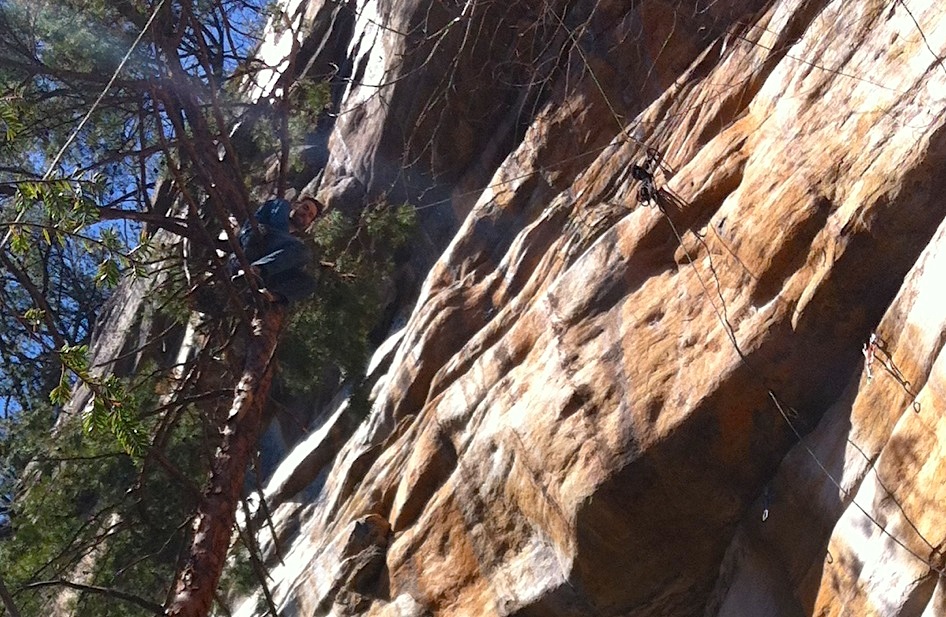
Several days into working the route, I has another cool realization. About 15ft behind the crux is a pine tree with a bunch of broken limbs. Because the route is so overhanging, it's possible to swing from the bottom of the crux to the tree. It occurred to me that I could do this while working the problem to avoid hanging in my harness. I've only done this once and it seemed better than hanging in the harness but still not as restful as being on the ground. Was fun for the novelty of it and if I had realized this earlier when I was working the moves more, it probably would have been more useful. Here's a photo of me resting in the tree.


So right now I'm sitting here getting over being sick! I've been sick for about the past 4 days and have missed out on some of best sending conditions right when I was about ready to start giving redpoint burns. I still got on the climb some, but it's hard to do much when I'm not feeling 100%. I'm hoping for a quick recovery that will leave me feeling great tomorrow because it's looking like it could be the last reasonable conditions till mid-April when I have to leave. The temperature is rapidly climbing into the 70s and the dew point is rising too. Rapunzel bakes in the sun and so generally feels hotter than the forecasted temp. Because the humidity is so high in the mornings, it's not really possible to climb on it then when it's cooler. We'll see how it goes, but I'm hoping to give some good attempts tomorrow. Really I only have one or two good redpoint attempts in a good day even.

Sunday, March 24, 2013

New River Update

Well, today was a rest day and the next few will be too given this forecast:


Fortunately the past two days were solid climbing days and I'm quite sore so the rest will be appreciated.

So far the weather has been pretty hit or miss---and mostly cold---but I've still managed to get in frequent climbing days. I'm four days of work into my Rapunzel project and at the verge of cracking it. two days ago I did the crux boulder problem in two overlapping sections. Hopefully I'll be able to piece the whole 8 move sequence my next day on the route. I have the 5.13 opening section fairly well dialed in and I climbed the pumpy but relatively juggy finish the other day without too much difficulty.

If the crux goes down on my next day, it may be game on in terms of switching from TR to the sharp end. That switch is always a bit difficult for me. Not because of the fear or danger associated with lead climbing. Rather, it's the switch from non-commitally working moves to the pressures of actually going for a send. Before every attempt it weighs on me whether I'll succeed or fail. This is a natural part of climbing and overcoming it can be rewarding. Nevertheless, the butterflies in the stomach are never welcome. I'm excited though for this transition and looking forward to giving burns and taking some good whippers. Usually I can overcome the butterflies by just telling myself that I'll go up and have fun on the route because the stone is beautiful, the moves are rad and being above gear is exciting. I try to fully accept the possibility of failure. Sometimes I worry that this attitude might hold me back because "I don't want it bad enough." That said, I go into every section with the attitude that I'm going to try my hardest so hopefully that is enough to make me perform at my limit without the extra baggage of the fear of failure.

This attitude worked for me yesterday on a sport route I was trying out at Beauty Mountain. Several days earlier, I was out there with the guidebook writer, Mike Williams, trying his route Picket Fence 14b. Mike hooked me up with a ton of beta for the cryptic sequences and I was able to figure them all out on my first go. I gave a redpoint burn at the end of that day for the hell of it and got pretty far into the crux sequence before I bungled a move (probably because of a mental mishap). Yesterday I got back on the route unsure of whether I was going to rework the moves or just go for a link. I pretty much just took it one move at a time and gauged how my body felt after each move. Things went well through the first boulder problem and then I found myself midway through the second boulder problem realizing that I had a chance at sending. I kept climbing one move at a time and was a bit shocked to soon be clipping the anchors. It was definitely a cool experience on a cool route. It was also nice to get some exposure to other 5.14s in the area to gauge the difficulty of the Rapunzel project. Check out this awesome video that LT11 put together of some sport routes in the new that includes Mike climbing Picket Fence.


Here's a photo I took of the bridge today with the bad weather closing in. Not really a great shot, but it shows the magnitude of the bridge here which never ceases to amaze me. This bridge is perhaps the most impressive feat of engineering I've ever witnessed. Truly inspiring that we can create things like this.


Hopefully the weather will clear soon and I'll have some good news to report when I post next. Until then, I'll be spending a lot of time huddling indoors, working on my computer, reading, and constantly watching my almost 2-year old who is beginning to earn the nickname "the destroyer." I'll also try to get some more photos of my project to better portray it visually.

Tuesday, March 12, 2013

Beginning my Sojourn in the New

So I arrived in Fayetteville, WV several days ago and will be climbing in the New River Gorge for the next month and a half. I'm super excited to be here and have some big plans. At the top of the list is this crazy trad project I've tried a few times in the past 3 years. I've never dedicated a long stretch of time to this line though so now is my chance.

The project climbs a beautiful slightly overhanging face to a horizontal crack with good gear. Then there's an extremely hard boulder problem that leads to easier 5.12 climbing above. The route is 100% gear and extremely aesthetic. Two days ago I got back on it and gave a few burns. It's still very much up in the air as to whether or not the boulder problem goes, but I think it's feasible. The climbing up to the crux is probably 13b or c with reasonable protection. The crux seems to be at least V12 but perhaps harder. If I can put this all together, it'll surely be one of the hardest gear routes out there.

Psyched to be out here and to have such a worthy project to devote my time to. I'm also excited to try to repeat some of the new classics the locals have been establishing and perhaps scope some other (hopefully slightly easier) projects to do while I'm here.

Here's a photo from the ground of my project. The route climbs the two gold streaks to the bulge above. Then it navigates mostly straight up through a series of steep bulges with perfect positive holds. Overall, the route probably is about 80ft high and overhangs about 30ft. I've dubbed the project the "Rapunzel Project" as you have to climb the golden locks of hair to get the prize.


I was out here for a few days a year and a half ago and put a little time into the route then. Check out this short video Pat Goodman put together of that trip which includes a few clips of me working the lower face on TR.


New River Gorge Projects from Pat Goodman on Vimeo.

Stay tuned for progress as I begin working on this more. Also wish me good luck in having the weather cooperate.

Monday, March 4, 2013

2013 ABS Nationals

Last weekend was the ABS junior nationals which I'm sure was a great show and the weekend before last I was down in Colorado Springs competing in the adult bouldering nationals. This year's field was probably the strongest yet with many seasoned veterans and a host of super-strong graduates of the ABS junior program. Each year the junior events get more and more competitive and the kids coming out of these are mutants. It's cool to see the progression of competition climbing, especially with the looming possibility of joining the olympics, but it makes my job harder and harder each year I decide to compete again.

I probably trained more this year than any past year and it payed off. I finished with my best final result yet and I broke the top ten with my qualifiers result. It's funny, though, for me training is just climbing on plastic as much as my body can handle. Although I'd like to campus and push myself more with supplementary training, it has always led to injury for me. I've found that the best course is for me to climb as many new gym problems as possible, often forcing myself to read them quickly, and train myself to be used to the rapid pace of climbing required in these comps. When you're climbing outdoors, you generally rest at least 5-15 minutes between serious burns (except for quick beta-figuring-out attempts). In the comps, however, you have only 4-5 minutes per problem to get it done and only 4-5 minutes of rest between problems. The pump loads up in your forearms quickly.

In the qualifiers, I climbed the first three problems fairly efficiently flashing each one. Even still, I was quite pumped after the long, steep third problem. I came out to the fourth with intensity, but I think I was lacking a bit of confidence that can be so necessary at times. I got to a hard move on the problem, I faltered. I know I was capable of doing the move and in fact I did it on my third try, but I didn't have that absolute belief in my ability when I was staring down the hold on my flash go. This is the mental aspect of comp climbing that is so essential and separates the best of the best from the rest. I was a bit disappointed that I flubbed the move twice. By the time I stuck the crux move, I was running out of time and was too tired to crank the finishing move. Still I had a good high point and was confident in my performance going into the final qualifiers problem.

The 5th problem was a slab which generally suits my style of climbing. That said, indoor slabs are quite  different than what you encounter on real rock. Generally, when the route setters make these slab problems, they use the slopiest holds they can find for hands and feet. In contrast, outdoor rock tends to be more edgy in nature. Nevertheless, the technique for both requires balance, finesse and good use of your feet. On my first two burns, I didn't trust my feet enough and they popped both times. Often, your feet stick better if you apply more pressure (i.e., trust them fully) than if you just put them lightly on the holds and try to hold most of your weight with your arms. With just a little time left, I was able to sneak through the sequence and top out the 5th problem for a 9th place finish.

Going into semifinals I was confident though slightly nervous and a bit shakey. This didn't help me on the first slab problem where I shook myself off before I could grab the second finishing hold. It didn't help me either that there wasn't a single less-than-vertical wall in the warm-up area to get used to standing on foot holds. The next two problems were challenging for me, but I was happy with my ability to stick the holds I did (of course thinking back I wish I could have done better). The final problem suited my style well and I managed to flash it. All in all, I made some mistakes in this round that I shouldn't have but I was happy with my end result which was a solid 14th place.

The worst part about these comps is that you can't go back and try the problems again. They are up for a moment in time and then gone forever. As I think back through the comp and go over some footage of myself climbing, I just keep feeling the desire to try the problems again and correct my mistakes. One of the things I love about these comps is how aesthetic the problems are. Generally they are striking singular lines and the moves are really fun and interesting. This makes for a great climbing experience; too bad it's so ephemeral. Talking about aesthetics, I think the route setters took things a bit too far this year. I really appreciate the improvements in route setting over the last 5 years... especially the use of volumes. That said, I think the attempt to make many problems appear symmetric is misdirected. Climbing is not about symmetry and these problems just aren't as fun to climb because the problem is held back by a silly constraint. Additionally, I don't think they are as good for the viewers because they are confusing (do you climb it with your right hand leading or your left hand leading?) An occasional point of symmetry is interesting and OK, but it was far overdone in this comp. Routesetters, strive to make every move the coolest you can and don't get caught up in trying to make your problem into a system board (otherwise, great job at the comp).

Here is some video footage I edited together from me climbing in the comp. A few problems are missing but this pretty well captures the important (and mentally painful) moments in the comp for me. With a 14th place finish, I should be invited to climb in the Vail world cup again which I think I'll do. That comp is always fun and a great challenge. Perhaps I can even make my goal of qualifying for semis in that event. It'll be tough this year though because I will be traveling a bunch right before the event and will have less time to train.


ABS 2013 Nationals Recap from Matt Wilder on Vimeo.

Monday, December 17, 2012

Amazing Weather Tool

So I'm planning a trip to the New River Gorge for this spring and I just came across this amazing site that I felt I had to share. This is invaluable for anyone planning a climbing trip and wanting to know the exact weather to expect. Go check out this site:

http://weatherspark.com

Choose your location and then select the average button below (or you can get current forecasts too).

I may be a data geek and that could be why I like this site so much, but it has so much good info!

Friday, December 14, 2012

Adjustable Toddler Bouldering Wall -- A Tutorial

So I build a little climbing wall for my 14 month old son. I've had a few requests for information on how I built it so I thought I'd make a post with some beta. Fortunately I took photos along the way so you can see the step by step process.

First off, a couple disclaimers: Of course all forms of climbing are dangerous and climbing on this wall can also be dangerous. Always spot your child (doh, ignore photo below) and always make sure the wall is completely stable. Also, note that once built, this wall is a bit heavy (especially with holds) but can usually be moved by 2 people. I didn't try to cut weight in the design, but I'm sure a much fancier, lighter version utilizing cutting edge space materials would be lighter.

OK, I put this draft together a few months ago and still haven't gotten around to finishing with all the instructions. Since I'm super busy trying to finish my PhD in a month, I've decided to just upload this post with the pics and let you figure out the materials and the steps. Hopefully the pictures give most of the info needed. Maybe in the future, I will try to expand this post with more details.

Thanks to Rock Candy Holds for helping me outfit the wall with great indoor climbing holds!


Friday, November 16, 2012

New Peru Video

So I'm back in Boulder after 2 successful slideshows. First I was part of the American Alpine Club's Craggin' Classic event in Bishop. The whole thing went really smoothly and was tons of fun. We started the day with some conservation work, then climbed in the Buttermilks during the middle of the day and finished with a party and slideshow out at Mill Creek Station. The room was packed for the show and there was a great vibe. It's cool giving shows in places that have such a rich climbing community.

The second show was in Atlanta at the Grassroots Outdoor Alliance meeting. They're a really cool organization that has rounded up a bunch of the retailers throughout the southeast. It was fun to share my show with these industry experts and I got a lot of positive feedback from them.

All in all it was a great week. At my shows, I premiered a new video I just edited of my trip to Peru. This video highlights the first half of the trip spent in Huayllay. Really amazing problems there. Almost everything we climbed on was an FA too which was really cool.

Enjoy!


Bouldering Adventures in Peru, Part 1: Huayllay from Matt Wilder on Vimeo.

Thursday, November 8, 2012

Bishop AAC Event This Weekend

I'm heading out to Bishop today. Psyched for the Fall Highball Craggin' Classic this Saturday. I'll be out at the Buttermilks during the day and then am giving a sliseshow in the PM. I'm customizing my show a bit for the Bishop crowd expanding on how important Bishop has been in the development of me as a climber. I'll be showing some photos of my earlier days there plus the never before seen footage of my first ascent of This Side of Paradise (very grainy footage unfortunately, but somewhat historical).

Here's an old photo of me on the FA of The Ninth in the Pollen Grains.

Tuesday, October 23, 2012

Gorilla Slap Down

Check out this video I was part of for the Access Fund. Good joke. Nice to support the Access Fund too because they do great things for our sport.


Matt Wilder - Tick Mark Master from Access Fund on Vimeo.

Thursday, September 27, 2012

Rock Candy Holds Video

Rock Candy Holds put together this cool short about me and my son and my new home woody. Fun little video, check it out.


Matt Wilder -The Sweet Life from Rock Candy Holds on Vimeo.

Wednesday, September 19, 2012

Abyss by LT11

I'm sure most of you have already checked out the great new free film by Louder Than 11 called Abyss. If you haven't, you got to check it out (http://abyss.lt11.com/). Interesting story, great imagery, many cool problems and cool graphics. It chronicles the development of a new bouldering area on Mt. Evans. Look for my short cameo neat the end with some footage of a cool V9 arete I did the FA of called Gold Blood.

Here's a sick image from the video of a lightning storm encountered at this high elevation area at 13,000ft.


Off to Independence Pass tomorrow for a couple days of bouldering. Should be fun and good conditions.